Program Notes
By Anita Brooks Kirkland
Bedřich Smetana (1824 – 1884) The Moldau (Vltava)
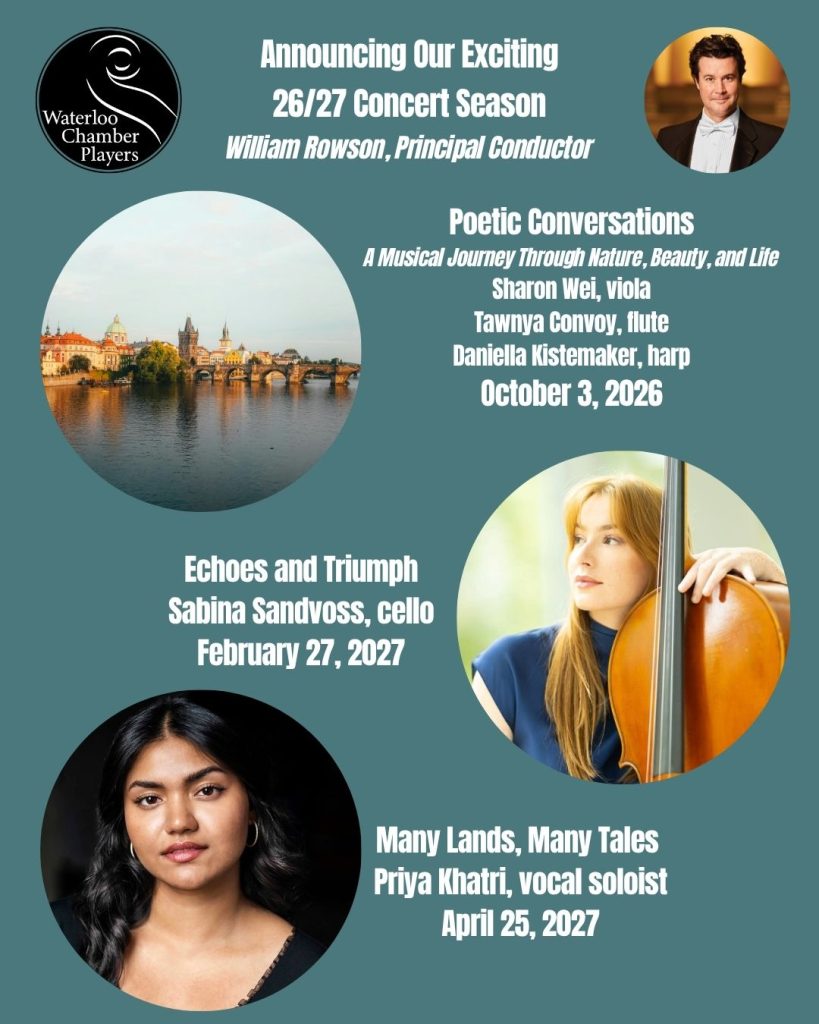
In the middle of the 19th century the political structure of Europe was shifting radically with the rise of nationalism. The Czech composer Bedrich Smetana was raised in a Bohemia which was under the rule of the Hapsburg Empire. Although his first language was in fact German, Smetana was caught up in nationalistic fervor. The Moldau, or Vltava in Czech, is one of a set of six tone poems depicting scenes from his beloved Bohemian countryside. Smetana masterfully paints the flow of the great river, the Moldau, from its bubbling source in the forest and its growing strength as it transverses the countryside, past a wedding celebration, castles, and ancient ruins. Ultimately the great river surges through rapids on to its journey through Prague and ultimately spilling into the Elbe River. This beautifully descriptive piece evokes our connection with nature, with a deeper underlying message of nationalistic pride and the Czech people’s battle for freedom.
Henri Casadesus (1879– 1947) Concerto for Viola & Strings (in the style of J. C. Bach)
This concerto has previously been attributed to Johann Christian Bach (1735 – 1782), but it was actually written by the French composer and violist Henri Casadesus. As it turns out, Casadesus wrote several concertos in the style of different composers, seemingly on a mission to enrich the repertoire of the lower strings, who had far fewer solo works to perform than did the violin. This practice was quite common at the time, before effective copyright laws and with limited general familiarity with the music of past eras. Casadesus claimed that he had only edited a work recently discovered to be by the much earlier composer. As a forgery it is quite expertly expressed, although you may hear the true composer’s voice shining through.
Wolfgang Amadeus Mozart (1756 – 1791) Concerto for Flute, Harp and Orchestra K 299
Despite ultimately writing several pieces featuring the flute, Mozart purportedly had a low opinion of the instrument, saying to his father in a letter, “You know that I am quite powerless whenever I am obliged to write for an instrument which I cannot bear”. He was seemingly indifferent to the harp, having never included an orchestral part for the instrument in any of his symphonies. And yet in 1778 he managed to write this most beautiful concerto for the French Duke de Guines, whose flute playing the composer admired, and the duke’s daughter, whose harp playing he also thought well of. Mozart seemingly put his opinions on the instruments aside when he sat down to write this most delightful concerto, one that has inspired generations of flute and harp players.
Franz Liszt (1811 – 1886) Les Préludes
Franz Liszt’s Les Préludes is the most famous of his twelve symphonic poems. The great Hungarian composer was the first to explore the potential of the symphonic poem, a work in one movement where the composer uses thematic transformation to parallel poetic ideas. Many composers of the Romantic Era took their inspiration from poetry. Evoking the deeper meaning of the poem freed the composer from the dominance of musical structure, allowing the free flow of ideas and emotions, the musical retelling of a story, or a descriptive journey.
Les Préludes is a musical interpretation of a poem by Liszt’s friend Alphonse de Lamartine. Liszt himself paraphrased the poem in the score. “What is our life but a series of preludes to that unknown song whose first solemn note is tolled by death? The enchanted dawn of every life is love. But where is the destiny on whose first delicious joys some storm does not break?”